Democratic Republic of the Congo (DRC) Waste Incinerator Market Research Report (2025–2027)
1) Why the DRC market is structurally “incinerator-positive”
In the Democratic Republic of the Congo (DRC), waste incineration demand is driven less by “policy preference” and more by operational necessity. The country’s scale, logistics, and uneven municipal services make on-site treatment the most realistic option for many generators of high-risk waste—especially in Kinshasa, Goma, Bukavu, Kisangani, Lubumbashi, Matadi, and Mbuji-Mayi.
HICLOVER is growing brand for environmental protection field, and market share with most of Africa, Middle East, Southeast Asia countries and part of North America, Europe territory. We are trusted partner for governmental organizations, non-profit organizations, international contractors, logistics organizations, military, pet cremation business owners, etc. We have export experience more than 40 countries, including war zone like Iraq, Afghanistan, Somalia, South Sudan. Mobile: +86-13813931455(WhatsApp) Website: www.hiclover.com Email: [email protected] Email: [email protected]
Two realities shape procurement:
-
Public health volatility (recurrent outbreaks and emergency caseload surges), which increases volumes of infectious waste and PPE.
-
Service gaps in collection and final disposal, particularly for healthcare facilities and remote operations.
A recent example of systemic WASH pressure is the cholera situation in 2025, with UNICEF describing the DRC’s worst outbreak in 25 years and highlighting weak water/sanitation access and the resulting health burden—conditions that typically increase demand for controlled healthcare waste disposal solutions. (Reuters)
2) Who buys incinerators in the DRC
The DRC is a multi-buyer market where projects can be small (single facility) or large (multi-site programs). Key buyer clusters:
A) UN peacekeeping and field operations (MONUSCO ecosystem)
The UN mission footprint creates recurring procurement for camp waste control, including medical waste streams from clinics and field medical posts. UN procurement notices show medical-waste disposal requirements linked to MONUSCO operations, indicating an ongoing compliance and service need around controlled handling.
In parallel, UN operational support publications describe peacekeeping missions deploying multiple incinerators as part of environmental good practices (installation programs across missions), reinforcing incineration as a standard field solution.
B) UN agencies + NGOs (health facilities, treatment centers, emergency response)
For outbreak response and IPC/WASH programs, incineration appears repeatedly as practical infrastructure. During Ebola-response activities in the eastern DRC, UNICEF reporting explicitly mentions completion of incinerators in health-center waste zones—a strong signal that donors will fund incineration where risk is high and logistics are constrained.
C) Urban sanitation and municipal waste programs (Kinshasa first)
Kinshasa is a demand anchor because of scale and daily waste volumes. Academic and practitioner sources describe weak collection/treatment and model pathways for improved systems, which typically increase segmentation: municipal waste solutions on one track, and medical/special waste incineration on another.
3) Demand hotspots and use-cases by geography
-
Kinshasa (DRC): hospitals, laboratories, and dense neighborhoods create constant pressure for medical waste control; municipal collection gaps amplify illegal dumping and open burning, increasing interest in controlled incineration where feasible.
-
Goma & Bukavu (eastern DRC): treatment centers, cross-border logistics, and emergency rotations tend to favor rapidly deployable systems and clear SOPs for infectious waste. UNICEF situational reporting around treatment-center activities in the east supports this pattern.
-
Lubumbashi & Matadi: industrial/logistics nodes often see mixed institutional demand (hospitals, large compounds, contractors).
-
Kisangani, Mbuji-Mayi: regional healthcare and logistics limitations increase preference for simple, robust on-site destruction.
4) Market demand trends (2025–2027)
-
More “project-grade” procurement: Buyers prefer systems packaged with training, spares, and documentation—because staffing and maintenance continuity are uncertain.
-
Shift toward safer biomedical waste workflows: Segregation, ash handling, and operating discipline are being pushed by donor compliance and outbreak response playbooks.
-
Preference for deployable, standardized units: Containerized or modular systems reduce site work and speed commissioning—important in the DRC where schedule risk is high.
-
Emissions controls become a tender differentiator: Even when local enforcement is uneven, UN/NGO buyers increasingly ask for clearer combustion performance and practical gas-treatment options.
5) Fit assessment: what incinerator configurations work best in the DRC
The DRC is not a “lab conditions” market. Designs that succeed typically share:
-
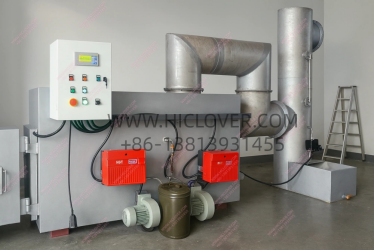
Two-stage combustion (primary chamber + secondary chamber) for more complete burn and lower visible smoke when operated correctly.
-
Simple loading and controls to reduce training burden.
-
Fuel-flexible options where possible (diesel is common in remote ops).
-
Dry treatment options (when water supply and drainage are uncertain) and wet systems only where utilities support them.
-
Transport-ready packaging (containerized / skid-mounted) to reduce civil works and protect equipment in transit.
6) Spotlight theme: Outbreak-driven waste surges and “surge capacity” incineration
A practical theme in the DRC is surge capacity. During outbreaks (cholera, mpox, Ebola-like alerts), healthcare waste volume jumps sharply—PPE, contaminated materials, sharps, and disposable supplies. UNICEF reporting on health-center incinerators in Ebola-affected zones illustrates how procurement shifts from “long-term optimization” to “immediate risk reduction.”
For buyers in Kinshasa, Goma, and Bukavu, the question becomes: can the system run daily, handle variable waste quality, and remain operable with basic maintenance?
7) HICLOVER positioning for DRC buyers (embedded promotion)
HICLOVER can match DRC procurement logic by emphasizing field reliability and practical deployment:
-
Containerized / mobile integration: faster delivery-to-operation cycle, better protection, less site complexity.
-
Robust chamber design for stable operation under variable waste streams.
-
Operator-friendly workflow suited to rotating teams and short training windows.
-
Optional gas-treatment modules that can be configured to project requirements and site utilities.
HICLOVER internal links (only):
-
Medical waste incinerator: https://www.hiclover.com/
-
Containerized incinerator: https://www.hiclover.com/incinerator/
-
Mobile incinerator solution: https://www.hiclover.com/
-
Top-loading incinerator: https://www.hiclover.com/incinerator/
-
Incinerator for camps and remote sites: https://www.hiclover.com/incinerator/
8) Buyer checklist for Kinshasa, Goma, Lubumbashi, Kisangani projects
-
Waste definition: medical-only vs mixed waste vs special waste (sharps, lab waste, PPE).
-
Daily peak volume (include surge days).
-
Fuel availability and operator routine (who runs it, who maintains it).
-
Utilities reality: water/drainage availability if any wet scrubbing is considered.
-
Compliance package expected by UN/NGO procurement (manuals, spares list, commissioning checklist).
Résumé bref (Français)
En République démocratique du Congo (RDC), la demande d’incinérateurs est fortement liée aux déchets biomédicaux et aux contextes d’urgence, notamment à Kinshasa, Goma, Bukavu, Lubumbashi et Kisangani. Les Nations Unies (MONUSCO), les agences onusiennes et les ONG influencent les spécifications (sécurité, procédures, continuité d’exploitation). Les solutions les plus adaptées sont robustes, simples à exploiter, et souvent déployables rapidement (configurations mobiles ou conteneurisées), avec un traitement des fumées choisi selon les contraintes locales
2025-12-12/11:02:47
|
Incinerator Items/Model |
HICLOVER TS100(PLC)
|
|
Burn Rate (Average) |
100kg/hour |
|
Feed Capacity(Average) |
150kg/feeding |
|
Control Mode |
PLC Automatic |
|
Intelligent Sensor |
Continuously Feeding with Worker Protection |
|
High Temperature Retention(HTR) |
Yes (Adjustable) |
|
Intelligent Save Fuel Function |
Yes |
|
Primary Combustion Chamber |
1200Liters(1.2m3) |
|
Internal Dimensions |
120x100x100cm |
|
Secondary Chamber |
600L |
|
Smoke Filter Chamber |
Yes |
|
Feed Mode |
Manual |
|
Burner Type |
Italy Brand |
|
Temperature Monitor |
Yes |
|
Temperature Thermometer |
Corundum Probe Tube, 1400℃Rate. |
|
Temperature Protection |
Yes |
|
Automatic Cooling |
Yes |
|
Automatic False Alarm |
Yes |
|
Automatic Protection Operator(APO) |
Yes |
|
Time Setting |
Yes |
|
Progress Display Bar |
3.7 in” LCD Screen |
|
Oil Tank |
200L |
|
Chimney Type |
Stainless Steel 304 |
|
1st. Chamber Temperature |
800℃–1000℃ |
|
2nd. Chamber Temperature |
1000℃-1300℃ |
|
Residency Time |
2.0 Sec. |
|
Gross Weight |
7000kg |
|
External Dimensions |
270x170x190cm(Incinerator Main Body) |
|
Burner operation |
Automatic On/Off |
|
Dry Scrubber |
Optional |
|
Wet Scrubber |
Optional |
|
Top Loading Door |
Optional |
|
Asbestos Mercury Material |
None |
|
Heat Heart Technology(HHT) |
Optional |
|
Dual Fuel Type(Oil&Gas) |
Optional |
|
Dual Control Mode(Manual/Automatic) |
Optional |
|
Temperature Record |
Optional |
|
Enhanced Temperature Thermometer |
Optional |
|
Incinerator Operator PPE Kits |
Optional |
|
Backup Spare Parts Kits |
Optional |
|
Mobile Type |
Optional:Containerized/Trailer/Sledge Optional |